
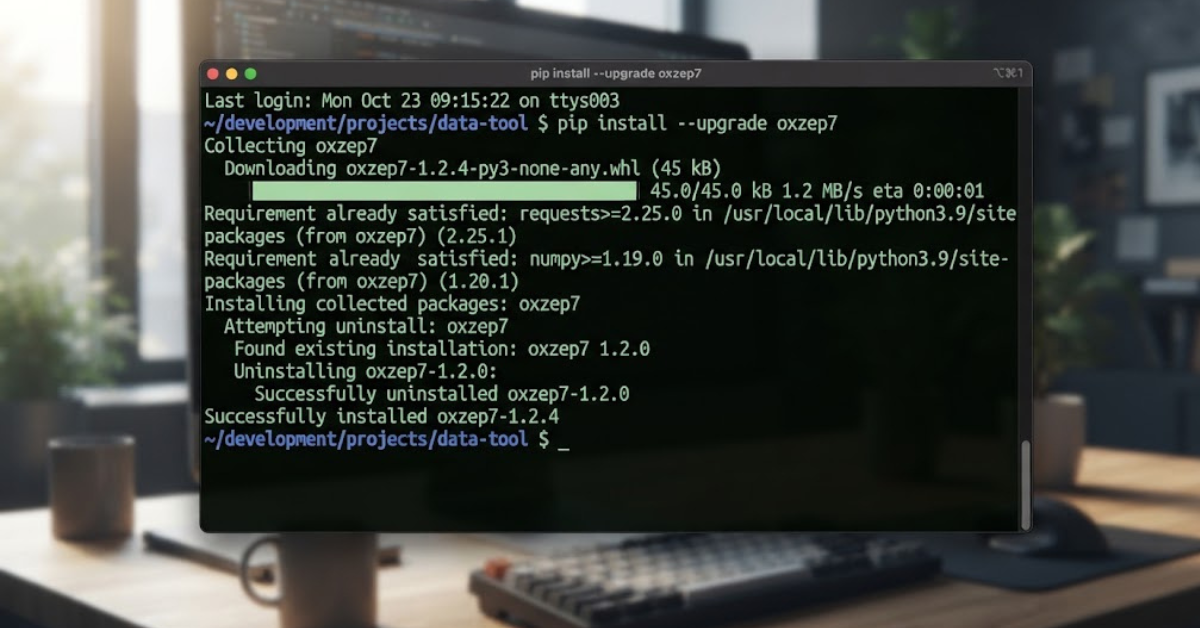
Searching for upgrade Oxzep7 Python can make the task sound straightforward: find the package, run an upgrade command, and continue working. But there is an important question to answer first—what exactly is Oxzep7?
That’s where things become confusing.
Several websites currently describe new software Oxzep7 Python as a Python library, framework, development toolkit, automation layer, or performance-focused tool. Other sources say they cannot verify Oxzep7 as a publicly recognized Python package at all.
A search for a software name is not enough to establish that it exists as an official Python project. Before changing an existing environment, developers should verify the package name, source, version, maintainer, and documentation.
This guide explains what can currently be established about Oxzep7, what upgrade Oxzep7 Python may mean in a real development environment, and how to handle the situation safely.
What Is Upgrade Oxzep7 Python?
The phrase upgrade Oxzep7 Python appears to describe updating a Python-based package, application, framework, or internal software component called Oxzep7.
However, that wording should not be mistaken for an official Python command.
Python itself has standard package-management mechanisms. The Python Packaging User Guide documents installing packages with pip, using virtual environments, maintaining requirements files, and upgrading verified packages with the --upgrade option.
For example, a legitimate package upgrade generally follows this pattern:
python -m pip install --upgrade package-nameThe important part is package-name.
You should replace it with the actual verified distribution name rather than assuming that oxzep7 is the correct package identifier.
Is Oxzep7 a Real Python Package?
At present, Oxzep7 does not have the public footprint normally associated with a well-established Python package.
Several recent articles explicitly report that they could not verify Oxzep7 through the normal Python ecosystem, while other websites confidently describe it as a framework or development toolkit.
That contradiction is significant.
A recognizable Python dependency will commonly have some combination of:
- A PyPI project page
- Official documentation
- A source-code repository
- Maintainer information
- Release history
- Version numbers
- Installation instructions
- Dependency information
- Community or developer references
The absence of those signals doesn’t prove that a private or internal project cannot exist. A company can maintain software internally without publishing it on PyPI.
But it does mean you should not assume that a random website describing “Oxzep7 Python” has identified a genuine public package.
Why Is New Software Oxzep7 Python Trending?
The phrase new software Oxzep7 Python appears across a collection of technology websites, often with highly confident descriptions.
Some articles claim that Oxzep7 provides:
- Automation
- Data processing
- Workflow management
- Performance optimization
- Asynchronous processing
- Development utilities
- AI-assisted functionality
- Modular application development
The problem is that these descriptions differ considerably from one source to another.
Some articles describe Oxzep7 as a lightweight Python module. Others call it a complete development platform. Still others describe it as an internal software layer rather than a conventional Python package.
Without a primary source, those feature lists should be treated as claims rather than established specifications.
Could Oxzep7 Be an Internal Python Project?
Yes, that’s one possibility worth considering.
Not every Python project is published publicly.
An organization might have an internal package called something like oxzep7 and distribute it through:
- A private PyPI-compatible index
- An internal artifact server
- A Git repository
- A company package registry
- A local wheel file
- A private source archive
- An internal deployment system
Python’s packaging documentation supports installing packages from alternative package indexes and from version-control repositories, so a package does not necessarily need to be publicly available on PyPI.
Therefore, if you encountered Oxzep7 inside a company project, the right question isn’t necessarily “Why can’t I find it on PyPI?”
Instead, ask:
Where does this project’s dependency actually come from?
How to Verify Oxzep7 Before an Upgrade
Before running an upgrade Oxzep7 Python command, establish what you already have installed.
Start by checking your project’s dependency files.
Look for:
requirements.txtpyproject.tomlPipfilepoetry.lockuv.locksetup.pysetup.cfg- CI/CD configuration
- Docker files
- Internal installation documentation
Search the project for:
oxzep7Also check for case variations if the project uses a different naming convention.
Check the installed environment
If you already have a Python environment associated with the project, inspect the installed packages.
For example:
python -m pip listor:
python -m pip freezeThe Python Packaging User Guide documents pip freeze as a way to record installed package versions, which can be useful when reproducing or backing up an environment.
If Oxzep7 doesn’t appear there, don’t assume that installing it from a random website is the correct next step.
Upgrade Oxzep7 Python Safely With a Virtual Environment
If Oxzep7 is confirmed to be a legitimate package used by your project, the safest approach is to upgrade it inside an isolated environment.
Python’s packaging documentation recommends virtual environments for keeping project dependencies separated.
Step 1: Create a backup or branch
Before changing dependencies, save your current work.
For a Git-based project, create a branch:
git checkout -b upgrade-oxzep7You should also make sure important data and configuration files are backed up.
Step 2: Create a virtual environment
On Windows:
py -m venv .venvOn macOS or Linux:
python3 -m venv .venvPython’s Packaging User Guide documents venv as a standard way to create isolated environments for project dependencies.
Step 3: Activate the environment
On Windows:
.venv\Scripts\activateOn macOS or Linux:
source .venv/bin/activateOnce activated, your package installation commands apply to that environment rather than your system-wide Python installation.
Step 4: Record the current dependencies
Before changing anything, create a record:
python -m pip freeze > requirements-before.txtThis gives you a useful reference if the upgrade introduces a problem.
Step 5: Upgrade pip
The Python Packaging User Guide documents upgrading pip with:
python -m pip install --upgrade pipOn Windows, the py launcher can also be used:
py -m pip install --upgrade pipStep 6: Upgrade the verified package
If your project’s documentation confirms that the actual package distribution is oxzep7, then a normal pip upgrade would follow the standard pattern:
python -m pip install --upgrade oxzep7Do not run this command simply because an article tells you to.
The package name must first be verified through your project’s trusted documentation, private package registry, PyPI listing, or source repository.
Why You Shouldn’t Blindly Run pip install --upgrade oxzep7
This is probably the most important warning in the entire guide.
The command:
python -m pip install --upgrade oxzep7looks perfectly normal.
But a normal-looking command doesn’t prove that the package exists, is trustworthy, or is the software you actually need.
If you run an installation command copied from an unknown website, you may:
- Install the wrong package
- Introduce an untrusted dependency
- Create dependency conflicts
- Change production behavior
- Break an existing environment
- Make debugging more difficult
Python’s official packaging guidance emphasizes installing from known package sources and using isolated environments.
The safest rule is simple:
Verify the package first. Upgrade it second.
Upgrade Oxzep7 Python From a Private Repository
If Oxzep7 is proprietary software, your organization may distribute it through a private package index.
Python’s packaging tools support alternate package indexes, including private repositories.
In that situation, your organization’s documentation may specify something similar to:
python -m pip install --upgrade --index-url <trusted-private-index> <verified-package>Don’t invent the index URL.
Use the exact repository provided by your organization’s development or infrastructure team.
Private software can be perfectly legitimate even when it has no public PyPI page. The critical issue is knowing who controls the repository and how the package is authenticated.
What If Oxzep7 Is Installed From Git?
Some Python projects are installed directly from version-control repositories instead of PyPI.
The Python Packaging User Guide documents installation from version-control systems, including Git repositories.
If your project uses this approach, inspect:
- Repository URL
- Organization or owner
- Branch
- Tag
- Commit
- Version information
- Authentication method
Don’t replace a trusted repository with an unrelated GitHub repository simply because it uses the same project name.
The repository itself is part of the software’s identity.
How to Test an Oxzep7 Python Upgrade
A successful installation doesn’t necessarily mean a successful upgrade.
After upgrading, test the application systematically.
1. Import test
If the package provides a Python module, verify that the project can still import it.
2. Unit tests
Run your existing test suite.
For example:
pytestif your project uses pytest.
3. Integration tests
Test the components that communicate with Oxzep7.
This could include:
- Databases
- APIs
- Background workers
- Web applications
- Data pipelines
- Authentication systems
4. Performance tests
If Oxzep7 is involved in processing large workloads, compare performance before and after the upgrade.
Look at:
- Execution time
- Memory consumption
- CPU usage
- Error rates
- Throughput
- Latency
5. Production-like testing
Don’t move directly from “it installed” to production.
Use a staging environment first whenever possible.
Common Problems During a Python Upgrade
Even when the package itself is legitimate, dependency upgrades can cause problems.
Dependency conflicts
One package may require an older version of another dependency.
For example:
Package A → dependency X < 3
Package B → dependency X >= 4
The package manager may be unable to satisfy both requirements.
Python version incompatibility
A newer package release may drop support for an older Python version.
Conversely, an older application may not work correctly with a very new Python runtime.
That’s why the project’s supported Python versions should be checked before upgrading.
Native extension problems
Packages containing compiled components can sometimes require compatible wheels or build tools.
If a pre-built wheel isn’t available for your Python version or operating system, installation may attempt to build from source.
Configuration changes
A software upgrade can change configuration formats, defaults, or environment variables.
Don’t assume that a successful installation means your existing configuration is still correct.
What to Do If the Upgrade Breaks Your Project
Don’t panic and start deleting packages randomly.
Instead:
Step 1: Capture the error
Save the complete traceback.
Step 2: Identify the first meaningful error
Long Python tracebacks can contain many lines, but the earliest underlying exception is often more useful than the final wrapper message.
Step 3: Compare versions
Check:
python --version
python -m pip --version
python -m pip freeze
Then compare the current environment with your pre-upgrade record.
Step 4: Reproduce in a clean environment
Create another virtual environment and install the project’s known dependencies.
This can reveal whether the problem is caused by the new package or by something already present in the original environment.
Step 5: Roll back if necessary
If the previous version worked reliably, reverting to the known-good version may be appropriate while you investigate the compatibility issue.
This is one reason keeping a dependency record before an upgrade is so useful.
New Software Oxzep7 Python: What Claims Should You Trust?
Search results currently contain some very confident descriptions of new software Oxzep7 Python.
Some claim that Oxzep7 is a next-generation framework with automation, AI support, data processing, modular development, and performance optimization. Others describe it as a lightweight toolkit or internal software layer.
The problem is that these descriptions aren’t supported by a single authoritative project source.
When evaluating a new Python tool, look for stronger evidence:
- Official repository
- PyPI project
- Maintainer identity
- Documentation
- Release history
- Source code
- Issue tracker
- Versioned changelog
- Reproducible installation instructions
If a page provides only broad claims and no verifiable project artifacts, treat its feature list cautiously.
New Software Oxzep7 Python and SEO-Driven Confusion
There is another reason to be careful.
Multiple websites now publish articles using almost identical phrases such as:
- New Software Oxzep7 Python
- Upgrade Oxzep7 Python
- What Is Oxzep7 Python?
- Oxzep7 Python installation
- Oxzep7 Python guide
That does not prove that the underlying software is fictional. But it does mean that the number of websites discussing a term should not be used as evidence that the term represents an established product.
A real technical project is best verified through its primary artifacts, not through how many SEO articles mention it.
Is New Software Oxzep7 Python Safe?
There is no reliable basis for declaring a generic “Oxzep7 Python” download safe.
There is also no basis for saying that every internal project using the name is malicious.
The correct approach is to assess the specific package or repository.
Before installing it, check:
- Publisher or maintainer
- Repository ownership
- Package source
- Digital signatures where applicable
- Release history
- Dependencies
- Security advisories
- Code-review process
- Whether the package is required by your project
If the only reason you’re installing it is that an unfamiliar website told you to, stop and investigate further.
A Safe Upgrade Checklist for Oxzep7 Python
If you genuinely have a verified Oxzep7 project, use this checklist before upgrading:
- Identify the exact package or repository.
- Confirm who maintains it.
- Record the current Python version.
- Record the current dependency versions.
- Back up important project files.
- Create a Git branch.
- Create a clean virtual environment.
- Install the known-good dependency set.
- Upgrade the verified Oxzep7 component.
- Run unit and integration tests.
- Compare performance.
- Test the application in staging.
- Monitor production carefully after deployment.
This process may seem slower than copying a command from a blog, but it greatly reduces the chance of turning a simple dependency update into a difficult debugging session.
Frequently Asked Questions About Upgrade Oxzep7 Python
What is upgrade Oxzep7 Python?
Upgrade Oxzep7 Python is a search phrase referring to updating a Python-related component called Oxzep7. However, Oxzep7 does not currently have a clearly verified public identity as a standard Python package, so the exact upgrade process depends on where the software came from.
Is Oxzep7 an official Python package?
There is currently no strong public evidence establishing Oxzep7 as a recognized standard Python package or framework. Several sources specifically report that they could not verify it through normal Python repositories, while other websites make unsupported claims about its capabilities.
Can I run pip install --upgrade oxzep7?
Only after verifying that oxzep7 is the correct package name and trusted source for your project. Python’s standard upgrade syntax uses python -m pip install --upgrade package-name, but that doesn’t establish that oxzep7 is a legitimate package.
What is new software Oxzep7 Python?
New software Oxzep7 Python is a phrase used by several websites to describe an alleged Python-related tool or framework. Those descriptions vary significantly, and there is not currently a single authoritative source establishing its identity or feature set.
How do I safely upgrade Oxzep7 Python?
First verify the package source, then back up the project, create a virtual environment, record current dependencies, upgrade the verified package, and run your test suite before deploying the change.
Could Oxzep7 be private software?
Yes. A company or development team could theoretically use Oxzep7 as an internal package or project name and distribute it through a private repository. A package doesn’t have to be public on PyPI to be legitimate.
Why can’t I find Oxzep7 on PyPI?
One possibility is that it isn’t a public PyPI package. It could instead be a private package, internal module, Git-based project, or simply an incorrectly reported software name. Don’t fill that gap by downloading a random package with the same name.
What should I do if an Oxzep7 upgrade causes errors?
Save the complete traceback, compare Python and dependency versions, reproduce the issue in an isolated environment, and check which dependency changed. If necessary, restore the known-good version while investigating compatibility.
Should I upgrade Python and Oxzep7 at the same time?
Not automatically. Changing the Python runtime and a dependency simultaneously makes troubleshooting harder because there are two major variables. Unless the project’s documentation specifically requires both changes, testing them separately can make problems easier to isolate.
Is Oxzep7 Python safe?
Safety depends on the specific software source. There is insufficient evidence to certify an unidentified Oxzep7 download as safe. Verify its maintainer, repository, dependencies, documentation, and security status before installing it.
Conclusion: What You Should Know About Upgrade Oxzep7 Python
The biggest lesson from the upgrade Oxzep7 Python search term is simple: verify before you upgrade.
There are numerous online articles describing new software Oxzep7 Python, but their explanations conflict. Some call Oxzep7 a Python framework, toolkit, automation system, or performance layer, while other sources report that they cannot verify a legitimate public package behind the name.
That uncertainty doesn’t mean an internal project using the name cannot exist. It does mean you should identify the actual package source before changing your Python environment.
If Oxzep7 is a legitimate dependency in your project, follow normal Python packaging practices: use a virtual environment, record current dependencies, verify the package source, upgrade deliberately, and test before deployment. Python’s official packaging documentation provides the underlying workflow for installing, upgrading, and managing dependencies safely.
And if you’re simply trying to find a new Python tool called Oxzep7 because you saw it mentioned online, don’t install the first package or command you find. Look for primary documentation, a trusted repository, a clear maintainer, and a reproducible installation process first.
In other words, the safest upgrade Oxzep7 Python strategy isn’t a magic command. It’s a careful verification and dependency-management process.