
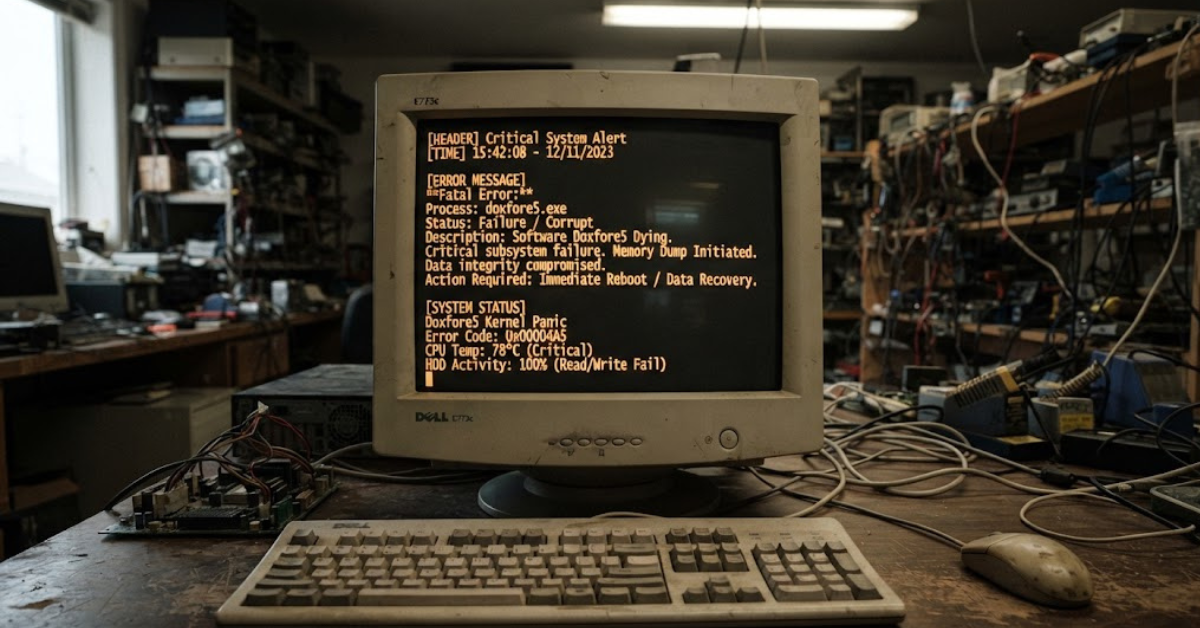
When software you’ve depended on for years suddenly becomes slower, harder to update, or increasingly difficult to integrate, one question naturally follows: is the sofware Doxfore5 dying?
The phrase “sofware doxfore5 dying” has appeared across several technology websites, usually in discussions about aging software, declining support, compatibility problems, and the possibility of moving to a newer platform. But there’s an important catch: the public information about Doxfore5 is surprisingly inconsistent.
Some websites describe Doxfore5 as an older document-management and workflow tool. Others make much stronger claims that it has entered end-of-life or critical decline. However, these claims largely come from third-party websites rather than a clearly identifiable official developer announcement.
So rather than simply declaring that Doxfore5 is “dead,” it’s more useful to examine what the available evidence actually suggests, what warning signs users should watch for, and what to do if the software is becoming unreliable.
Is Software Doxfore5 Dying?
The short answer is: there are signs of concern, but an official discontinuation cannot be confidently confirmed from the available public information.
Several recent articles characterize Doxfore5 as legacy software that is struggling to keep pace with modern applications. They point to slower development, compatibility concerns, limited integrations, outdated interfaces, and reduced support as possible reasons users are asking whether the product is dying.
Other websites go considerably further, describing Doxfore5 as being in “critical decline” or already in an end-of-life stage. Those statements should be treated cautiously because the sources do not provide a clearly verifiable vendor announcement establishing an official shutdown date.
That’s an important distinction.
A product can be declining without being officially discontinued.
Software may remain functional for years after active development slows down. The bigger concern is whether it continues receiving security updates, operating-system compatibility fixes, technical support, and integration updates.
What Does “Dying Software” Actually Mean?
The word dying can sound dramatic, but it has a fairly practical meaning in software discussions.
It usually describes a product that is gradually becoming less viable rather than one that suddenly stops working.
Typical signs include:
- Fewer software updates
- Longer delays between bug fixes
- Declining technical support
- Outdated integrations
- Compatibility problems with newer operating systems
- An inactive developer community
- Increasing difficulty finding documentation
- Modern competitors offering substantially more functionality
This is why a program can still open normally while users reasonably describe it as “dying.”
The question isn’t simply:
Does the software still run?
It’s:
Can I safely depend on it for the next several years?
That’s a much more useful question.
Why Are People Searching for “Sofware Doxfore5 Dying”?
The unusual spelling “sofware doxfore5 dying” appears to be the exact search phrase used by people looking for information about Doxfore5’s future.
Current articles associate the phrase with several concerns.
Aging technology
Some sources describe Doxfore5 as legacy document or workflow software that has struggled to keep pace with newer cloud-based platforms.
Limited development
Several articles claim that updates and improvements have become less frequent.
However, without an official release history from a verified vendor, this remains difficult to independently confirm.
Compatibility concerns
Older software can become increasingly difficult to run as operating systems, browsers, security standards, and third-party dependencies change.
Integration problems
Modern businesses often expect software to connect with cloud storage, CRM systems, accounting platforms, identity providers, APIs, and collaboration tools.
Legacy software can struggle when those surrounding systems change.
Uncertainty about support
This may be the biggest concern of all.
If you cannot easily determine who currently maintains a piece of business-critical software, planning around it becomes difficult.
Is Doxfore5 Actually Obsolete?
It’s too early to make that statement categorically.
Some online sources call Doxfore5 obsolete or unsupported, while others describe it as an aging but still usable document and workflow platform.
The problem is the lack of a clearly established primary source that allows users to verify the software’s current lifecycle status.
If you currently use Doxfore5, don’t decide whether it is obsolete based on a blog post alone.
Instead, check your own environment.
Look at:
- The version currently installed
- The date of the last update
- The developer or vendor
- The latest available release notes
- Security-patch history
- Operating-system compatibility
- Integration compatibility
- Support availability
- Backup and export options
- Whether your organization can migrate its data
These factors will tell you much more about your actual risk.
Signs That Software Doxfore5 May Be Declining
If you’re already using Doxfore5, there are several practical warning signs worth monitoring.
1. Updates become increasingly rare
A long gap between releases isn’t automatically proof of abandonment.
But if updates stop entirely while the surrounding technology continues changing, the risk increases.
2. Bugs remain unresolved
Every application has bugs.
The concern is what happens afterward.
If important issues remain unresolved for months or years, that may indicate that development resources have declined.
3. New operating systems cause problems
A legacy application may work perfectly on an older computer but begin experiencing problems after an operating-system upgrade.
Watch for:
- Crashes
- Missing components
- Display problems
- Permission errors
- Installer failures
- Broken integrations
4. Integrations stop working
Modern software rarely operates alone.
If a CRM changes its API or an authentication provider updates its security requirements, older software may suddenly stop communicating correctly.
5. Support becomes difficult to reach
Support quality is often one of the clearest practical indicators of a product’s health.
If questions increasingly go unanswered or documentation becomes outdated, users should start considering contingency plans.
Why Legacy Software Can Become Risky
Older software isn’t automatically bad.
In fact, a stable legacy application can sometimes be more reliable than a brand-new product.
The problem appears when the surrounding environment changes faster than the software itself.
Imagine a document-management application that still works perfectly—but depends on:
- An outdated database
- An old authentication method
- An unsupported operating system
- An obsolete browser component
- An aging API
- A discontinued plugin
The application may continue working today.
But every dependency introduces another potential failure point.
That’s why software lifecycle management matters.
Security Is More Important Than Appearance
One of the easiest mistakes is judging software health by whether the application still opens.
A program can look perfectly normal while containing unresolved security weaknesses.
If Doxfore5 handles sensitive documents, customer records, financial information, intellectual property, or regulated data, security support becomes especially important.
Before continuing to rely on an aging application, determine:
- When it last received a security update
- Whether security issues are still being addressed
- Which operating systems it officially supports
- Whether its dependencies remain supported
- How authentication is handled
- Where sensitive data is stored
- Whether audit logs remain available
Don’t assume that “it still works” means “it is still safe.”
What If Doxfore5 Is Still Working Fine?
This is where things get interesting.
If Doxfore5 works reliably today, you don’t necessarily need to rip it out tomorrow.
Migration itself introduces risk.
Moving a large document repository or workflow system can cause:
- Data-format problems
- Lost metadata
- Broken permissions
- Workflow disruptions
- Training costs
- Integration failures
- Unexpected downtime
Instead, use a planned migration strategy.
Continue operating the existing system while investigating alternatives, testing exports, and documenting dependencies.
That gives you a fallback rather than forcing an emergency replacement.
Should You Replace Doxfore5?
The answer depends on your situation.
You should seriously investigate alternatives if:
- Your vendor support is unavailable
- Security updates have stopped
- Important integrations are breaking
- Your operating system is no longer supported
- Performance is declining
- You cannot reliably back up your data
- The software cannot export information in usable formats
- Your organization is becoming dependent on unsupported components
On the other hand, replacement may not be urgent if:
- The software is still officially supported
- Security updates are current
- Your integrations work reliably
- Your data is backed up
- Your operating environment remains supported
- There is a clear support channel
The goal isn’t to replace old software simply because it’s old.
The goal is to avoid being trapped by it.
How to Safely Move Away From Doxfore5
If you’ve concluded that software Doxfore5 dying is becoming a real operational concern, don’t start by deleting the application.
Start with your data.
Step 1: Inventory the system
Document:
- Applications
- Databases
- File locations
- Integrations
- User accounts
- Permissions
- Scheduled tasks
- Plugins
- APIs
- Export formats
You may discover that Doxfore5 is connected to far more systems than expected.
Step 2: Back up everything
Create verified backups before making major changes.
Don’t assume that an application export is automatically a complete backup.
Test whether you can actually restore the information.
Step 3: Export a sample
Before migrating millions of files or records, export a small representative dataset.
Check:
- File names
- Metadata
- Permissions
- Timestamps
- Version history
- Searchability
- Relationships between documents
Step 4: Test a replacement
Choose a potential alternative and run a pilot.
Don’t migrate the entire organization on day one.
Step 5: Run systems in parallel
Where practical, operate the old and new environments simultaneously for a limited period.
This gives users time to identify problems before the old system disappears.
Step 6: Create a rollback plan
Every migration should answer one question:
What happens if something goes wrong?
If the answer is “we’ll figure it out,” the migration isn’t ready.
What Alternatives Should You Consider?
There isn’t one universal replacement for Doxfore5.
The right alternative depends on what you actually use it for.
If your primary need is document management, prioritize:
- Search
- Version control
- Permissions
- Audit trails
- Document workflows
- Collaboration
- Reliable exports
If workflow automation is more important, evaluate:
- API support
- Workflow builders
- Integration options
- Authentication
- Monitoring
- Automation reliability
For cloud-focused organizations, also consider:
- Data residency
- Security controls
- Backup policies
- Vendor support
- Compliance requirements
- Pricing
- Migration tools
Don’t choose a replacement simply because it has a longer feature list.
Choose the platform that solves your actual operational requirements.
Common Mistakes When Dealing With Doxfore5
Mistake 1: Assuming every slowdown means the product is dead
Performance problems can result from local hardware, databases, networks, configuration, or integrations.
Diagnose the actual issue before declaring the platform finished.
Mistake 2: Waiting for an outage before planning
This is probably the most expensive mistake.
Migration planning takes time.
Start while the old system still works.
Mistake 3: Trusting unsupported claims online
Current Doxfore5 articles make conflicting claims about its lifecycle. Some say it is in critical decline; others describe it as legacy software.
Verify important lifecycle information through the vendor or your organization’s software records.
Mistake 4: Migrating without testing exports
A backup is only useful if you can actually restore the data.
Test it.
Mistake 5: Replacing functionality without documenting workflows
Software often contains years of accumulated business logic.
Document what the system actually does before replacing it.
A Practical Doxfore5 Health Check
If you want to know whether your own Doxfore5 environment is becoming a liability, score it against these questions:
| Question | Healthy | Warning |
| Recent updates available? | Yes | No |
| Security support? | Confirmed | Unknown |
| Vendor support? | Responsive | Difficult/unavailable |
| OS compatibility? | Current | Aging |
| Integrations? | Stable | Frequently breaking |
| Backups? | Tested | Untested |
| Data export? | Easy | Difficult |
| Documentation? | Current | Outdated |
| Replacement plan? | Ready | None |
A single warning doesn’t necessarily mean you need to migrate.
Several warnings together deserve attention.
Frequently Asked Questions
Is software Doxfore5 dying?
There are multiple third-party articles claiming that Doxfore5 is declining, outdated, or approaching end-of-life. However, the available public evidence does not provide a sufficiently clear official vendor announcement to conclusively say that Doxfore5 has been discontinued.
Why do people say software Doxfore5 is dying?
The phrase is associated with claims about slower development, outdated technology, compatibility issues, limited integrations, and declining support. These are recurring themes in third-party coverage, although individual claims should be verified before being treated as established facts.
Is Doxfore5 still usable?
If you already have a working installation, it may continue to function. But whether it is appropriate for long-term use depends on its current support, security, compatibility, integrations, and ability to protect and export your data.
Is Doxfore5 obsolete?
Some websites describe it as obsolete or legacy software, but those descriptions are not enough by themselves to establish an official end-of-life status. Check the software’s actual version, vendor documentation, support status, and security history.
Should I replace Doxfore5 now?
Not necessarily. If your system is stable and supported, you can use the time to plan a controlled migration. If security support, compatibility, integrations, or backups are already failing, replacement should become a higher priority.
What are the signs that Doxfore5 is dying?
Common warning signs include increasingly rare updates, unresolved bugs, compatibility problems, broken integrations, poor support, outdated documentation, and difficulty maintaining the surrounding infrastructure.
How can I migrate from Doxfore5 safely?
Start by inventorying the system, creating and testing backups, exporting a representative sample, evaluating alternatives, running a pilot migration, and maintaining a rollback plan.
Can old software still be safe?
Yes, but age alone doesn’t determine security. The key questions are whether vulnerabilities are still addressed, whether the underlying operating environment is supported, and whether the software can be maintained securely.
What should I do if Doxfore5 suddenly stops working?
Don’t assume the software has reached end-of-life. First check the complete error message, recent operating-system or application changes, network connectivity, dependencies, logs, and integrations. If the issue is widespread or support is unavailable, begin evaluating contingency options.
Conclusion: Is Software Doxfore5 Dying?
The phrase “sofware doxfore5 dying” reflects a legitimate question about the future of an apparently aging software product, but the available public evidence doesn’t justify treating every claim about its death or end-of-life as fact.
Several third-party sources describe Doxfore5 as legacy software facing challenges from newer technologies, limited development, compatibility problems, and changing user expectations. Others make much stronger claims about critical decline or end-of-life, but those claims are not clearly backed by an identifiable official announcement.
For current users, the practical lesson is more important than the label.
Don’t wait for software to completely fail before preparing for what comes next.
Check your support status, security updates, integrations, backups, and export options now. If several of those areas are already showing warning signs, begin testing alternatives while Doxfore5 is still operational.
And if the software continues to meet your needs, there’s no reason to panic simply because an article says it is “dying.” Verify the facts, assess your actual environment, protect your data, and make migration a planned decision rather than an emergency.