
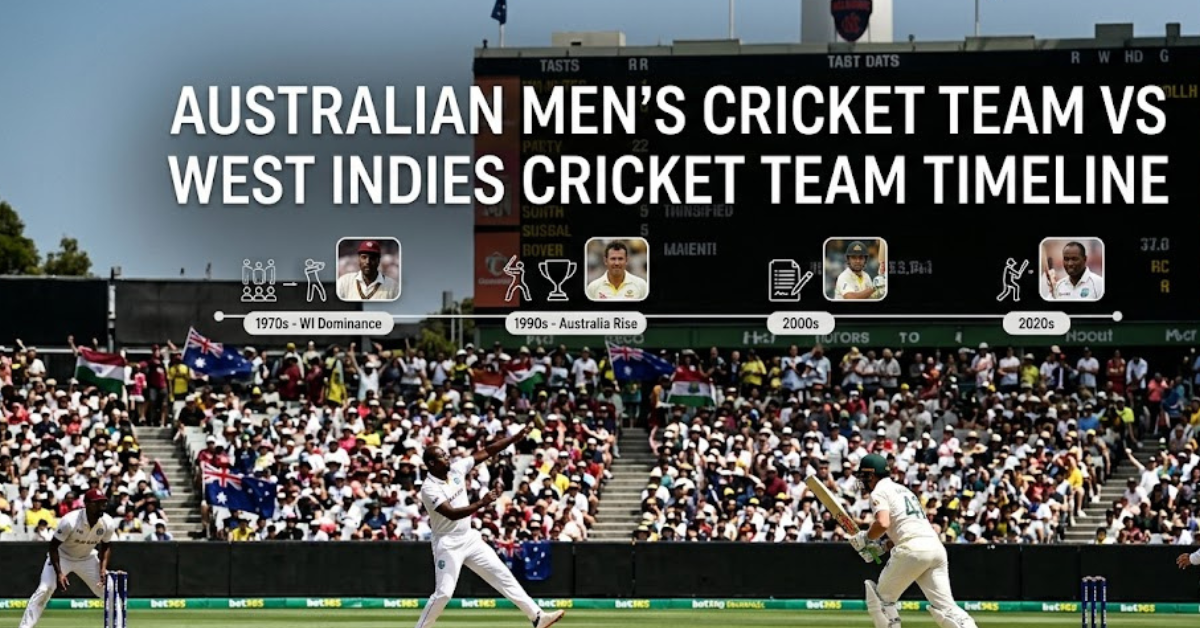
When two of cricket’s most historic teams meet, the scorecard rarely tells the whole story. The Australian men’s cricket team vs West Indies cricket team timeline stretches back nearly a century and includes legendary players, dominant eras, World Cup classics and some remarkable Test match comebacks.
The rivalry has changed dramatically over the years. West Indies once ruled Test cricket with a devastating pace attack, Australia later established its own era of dominance, and recent meetings have shown that the Caribbean side can still produce stunning upsets.
Here is a chronological look at the most important West Indies cricket team vs Australian men’s cricket team matches, including the moments that shaped this long-running rivalry.
Australian Men’s Cricket Team vs West Indies Cricket Team Timeline: At a Glance
The rivalry can broadly be divided into several important periods:
- 1930: West Indies and Australia meet in Test cricket for the first time.
- 1972–73: Australia win a Test series in the Caribbean.
- 1975: West Indies beat Australia in the first men’s Cricket World Cup final.
- 1975–76: Australia win the Test series 5–1.
- 1983–85: West Indies dominate Australia across two Test tours.
- 1995: Australia end West Indies’ long unbeaten Test-series run.
- 1996: Australia beat West Indies by five runs in a World Cup semi-final.
- 1997: West Indies record their last Test victory in Australia for more than two decades.
- 2006: Australia defeat West Indies in the Champions Trophy final.
- 2015: Australia sweep a two-Test series in the Caribbean.
- 2019: Australia beat West Indies by 15 runs at the World Cup.
- 2022: Australia win a two-match T20I series 2–0.
- 2024: West Indies stun Australia at the Gabba to draw the Test series.
- 2025: Australia sweep the three-Test series in the Caribbean.
That sequence alone shows why Australia vs West Indies has remained one of international cricket’s more fascinating rivalries.
1930: The Rivalry Begins in Test Cricket
The first major chapter in the West Indies cricket team vs Australian men’s cricket team timeline came in 1930.
West Indies were still a relatively new Test nation, having made their Test debut against England in 1928. When they toured Australia in 1930, they secured their first overseas Test victory by defeating Australia by 30 runs in the fifth Test. Australia nevertheless won the five-match series 4–1.
That tour was significant beyond the final series score. It established Australia as a major challenge for the developing West Indies side and gave the Caribbean team an important early milestone: an overseas Test win.
1972–73: Australia Win in the Caribbean
More than four decades later, the rivalry entered a much more competitive phase.
Australia, led by Ian Chappell, toured the West Indies for a five-Test series. Australia won 2–0, with three matches drawn.
It was a particularly important result because winning a Test series in the Caribbean was never straightforward. Australia had to deal with unfamiliar conditions and a West Indies side containing players such as Roy Fredericks and Lance Gibbs.
The series also helped establish the Sir Frank Worrell Trophy as an important symbol of the Test rivalry.
1975: The First World Cup Final
If there is one date that belongs near the top of any Australia vs West Indies timeline, it is June 21, 1975.
The first men’s Cricket World Cup ended with West Indies facing Australia at Lord’s. Clive Lloyd’s team made 291/8, with Lloyd scoring a brilliant 102. Australia fought back but was eventually dismissed for 274, giving West Indies a 17-run victory and the first World Cup title.
The match became one of the defining games in early ODI history.
It also featured one of the most memorable innings of the tournament. Lloyd walked in when West Indies were 50/3 and transformed the innings with an explosive century. Australia’s chase was then undermined by five run-outs.
Why the 1975 final matters
It established several themes that would follow this rivalry:
- West Indies’ ability to dominate on the biggest stage
- Australia’s competitiveness under pressure
- Clive Lloyd’s emergence as a great captain
- The growing importance of one-day international cricket
1975–76: Australia Strike Back
The response came almost immediately.
After losing the 1975 World Cup final, West Indies toured Australia for a six-Test series. Australia won the series 5–1, with Greg Chappell scoring 702 runs and Jeff Thomson taking 29 wickets.
This series became a turning point in West Indies cricket.
The Caribbean side experienced the frightening pace of Australia’s Dennis Lillee and Jeff Thomson. West Indies subsequently developed the famous strategy of building their own attack around several high-quality fast bowlers.
In many ways, this was the beginning of the West Indies fast-bowling dynasty that would dominate international cricket during the following decade.
1983–85: The West Indies Pace Era
By the early 1980s, the balance had shifted dramatically.
West Indies had assembled a frightening group of fast bowlers, including Malcolm Marshall, Joel Garner, Michael Holding and Andy Roberts. Australia increasingly found itself facing an attack capable of applying pressure from both ends for long periods.
During the 1983–84 tour of the Caribbean, West Indies won the five-Test series 3–0, with two matches drawn.
The one-day contests also reflected West Indies’ strength. During the 1983–84 World Series Cup in Australia, West Indies reached the final against the hosts and won the best-of-three final series 2–0.
Then came another important series in Australia.
1984–85: West Indies dominate again
West Indies won the five-Test series in Australia 3–1, with one match drawn. The first three Tests went to the Caribbean side, while Australia managed to avoid defeat in Melbourne before winning the fifth Test.
This period represents the high point of West Indies’ dominance in the rivalry.
1995: Australia Finally Break West Indies’ Test Dominance
The 1995 Australia vs West Indies Test series was one of the most important turning points in the entire rivalry.
Australia travelled to the Caribbean under Mark Taylor. West Indies had not lost a Test series since 1980, making the challenge enormous. Australia eventually won the four-Test series 2–1, with one match drawn.
Steve Waugh was outstanding, scoring 429 runs across the series.
For Australia, the result represented much more than another series victory. It marked the end of West Indies’ extraordinary run of Test-series dominance and signalled the beginning of Australia’s own rise toward the top of world cricket.
1996: A Five-Run World Cup Thriller
The following year produced another classic in the West Indies cricket team vs Australian men’s cricket team matches.
Australia and West Indies met in the 1996 World Cup semi-final at Mohali. Australia struggled badly at the start and slipped to 15/4, but Stuart Law and Michael Bevan helped rebuild the innings as Australia reached 207/8.
West Indies appeared to be in control at 165/2, but Shane Warne changed the match with a spell of 4/36. West Indies were bowled out for 202, and Australia won by just five runs.
It was one of the closest and most dramatic World Cup matches between the sides.
The key numbers
- Australia: 207/8
- West Indies: 202
- Result: Australia won by 5 runs
- Venue: Mohali
- Player of the Match: Shane Warne
1997: West Indies’ Last Test Win in Australia for Many Years
West Indies responded the following season with another memorable performance.
In the fifth Test of the 1996–97 tour, West Indies defeated Australia in Perth by 10 wickets. Curtly Ambrose produced a spectacular 7/93.
That remained West Indies’ most recent Test victory in Australia until their extraordinary Gabba success in 2024. The ICC described the 2024 win as West Indies’ first Test victory in Australia since February 1997.
2000s: Australia’s Dominance Takes Over
The new millennium brought a different dynamic.
Australia’s Test and ODI teams became increasingly dominant, with players such as Ricky Ponting, Adam Gilchrist, Matthew Hayden, Glenn McGrath and Shane Warne forming the core of one of the strongest sides in modern cricket.
West Indies still possessed extraordinary individual talent, particularly Brian Lara and Chris Gayle, but Australia generally had greater consistency across formats.
One major meeting came in the 2006 ICC Champions Trophy final.
West Indies were bowled out for 138, while Australia chased the revised target after rain and won by eight wickets. Nathan Bracken took 3/22, while Shane Watson was named Player of the Match.
2015: Australia Sweep the Test Series
The teams met again in the Caribbean in 2015 for a two-Test series.
Australia won both matches and completed a 2–0 series sweep. The second Test in Kingston ended in a huge 277-run Australian victory after West Indies were bowled out for 114 in their second innings.
The series illustrated the changing balance of power.
Australia had moved into another period of sustained Test strength, while West Indies were struggling to reproduce the consistency of their great teams from previous decades.
2019: Another Close World Cup Encounter
Australia and West Indies met again at the 2019 Cricket World Cup in Nottingham.
Australia scored 288, with Steve Smith making 73 and Nathan Coulter-Nile contributing a crucial 92. West Indies responded with 273/9, but Australia held on to win by 15 runs.
It was another reminder that World Cup meetings between these teams often produce much closer contests than their overall records might suggest.
2022: Australia Win the T20I Series
The rivalry eventually expanded fully into the shortest format.
Australia hosted West Indies for two T20Is in October 2022. Australia won both matches, taking the series 2–0.
The games reflected how dramatically cricket had changed since the teams first met in 1930. Rather than five-day Tests or 60-over World Cup matches, the contest was compressed into 20 overs per side.
2024: The Gabba Miracle
Perhaps the most surprising recent chapter in the Australian men’s cricket team vs West Indies cricket team timeline came in January 2024.
Australia won the opening Test in Adelaide, but West Indies produced a sensational response in Brisbane.
Chasing 216, Australia were dismissed for 207. Shamar Joseph took 7/68, helping West Indies win by just eight runs. It was West Indies’ first Test victory in Australia since 1997.
The result was particularly remarkable because the West Indies side was relatively inexperienced.
Why the Gabba Test was so significant
The match demonstrated that the rivalry was not simply a story of Australia’s modern dominance.
It showed that:
- West Indies could still win a Test in Australia.
- A new generation of Caribbean players could produce historic performances.
- The rivalry retained its unpredictability.
- Shamar Joseph immediately became associated with one of the most memorable recent West Indies victories.
The two-Test series finished 1–1, making the Gabba result even more significant.
2024 T20 Cricket: A Different Kind of Contest
The teams also crossed paths in the T20 era around the 2024 Men’s T20 World Cup.
Before the tournament, West Indies defeated Australia by 35 runs in a warm-up match in Trinidad. Nicholas Pooran scored 75 from 25 balls as West Indies posted 257/4.
That result highlighted something important about modern Australia vs West Indies cricket: while Australia’s depth has often made it the stronger side across formats, West Indies’ explosive batting can make them dangerous in T20 cricket.
2025: Australia Regain Control in the Caribbean
The next major Test chapter arrived in 2025.
Australia toured the West Indies for a three-Test series, with the opening match beginning in Barbados in June.
Australia eventually completed a 3–0 series sweep. The third Test in Kingston produced one of the most extraordinary scorecards in recent Test history, as West Indies were dismissed for just 27 in their second innings. Mitchell Starc took 6/9 and Scott Boland claimed a hat-trick as Australia won by 176 runs.
The series was therefore a sharp contrast to the Gabba story from just a year earlier.
West Indies had shown in 2024 that they could defeat Australia in Australia’s own conditions. In 2025, Australia responded by winning every Test in the Caribbean.
West Indies vs Australia: How the Rivalry Has Changed
The most interesting thing about this timeline is that neither team has remained permanently dominant.
1. Early years: Australia had the advantage
Australia won the first Test series between the sides in 1930 and remained a formidable opponent as West Indies developed.
2. 1970s: The rivalry became a heavyweight contest
The 1975 World Cup final and the 1975–76 Test series created a fascinating exchange.
West Indies won the World Cup final, while Australia won the subsequent six-Test series 5–1.
3. 1980s: West Indies rule Test cricket
The Caribbean side became the dominant force, powered by one of the greatest fast-bowling groups ever assembled.
4. 1990s: Australia begins its takeover
Australia’s 1995 series win in the Caribbean was a landmark. The 1996 World Cup semi-final then added another iconic chapter.
5. 2000s–2010s: Australia generally holds the upper hand
Australia became the more consistent team, particularly in Test and ODI cricket.
6. 2020s: The rivalry becomes less predictable
The 2024 Gabba victory showed that West Indies could still shock Australia. The 2025 3–0 Australian sweep demonstrated the opposite just a year later.
Major Australia vs West Indies Matches to Remember
If you only want the most important West Indies cricket team vs Australian men’s cricket team matches, these are worth knowing:
| Year | Match/Event | Result |
| 1930 | First Test series between the teams | Australia won 4–1 |
| 1972–73 | Test series in West Indies | Australia won 2–0 |
| 1975 | First World Cup final | West Indies won by 17 runs |
| 1975–76 | Six-Test series in Australia | Australia won 5–1 |
| 1983–84 | Test series in West Indies | West Indies won 3–0 |
| 1984–85 | Test series in Australia | West Indies won 3–1 |
| 1995 | Test series in West Indies | Australia won 2–1 |
| 1996 | World Cup semi-final | Australia won by 5 runs |
| 1997 | Test in Perth | West Indies won by 10 wickets |
| 2006 | Champions Trophy final | Australia won by 8 wickets |
| 2015 | Two-Test series in West Indies | Australia won 2–0 |
| 2019 | World Cup match | Australia won by 15 runs |
| 2022 | T20I series | Australia won 2–0 |
| 2024 | Gabba Test | West Indies won by 8 runs |
| 2025 | Three-Test series in West Indies | Australia won 3–0 |
Why the Australia vs West Indies Rivalry Still Matters
Modern cricket has produced many newer rivalries, but Australia vs West Indies carries something different: history.
The teams have experienced almost every possible cricketing scenario together. They have played for World Cup titles, fought through brutal Test series, produced last-over finishes and witnessed entire generations of players rise and disappear.
The rivalry also tells a broader story about international cricket.
West Indies went from being a developing Test nation to becoming the most feared side in the world. Australia then challenged that dominance and eventually built its own era of supremacy. Today, both teams are navigating different stages of rebuilding and competition.
That historical context makes every new West Indies vs Australia series more interesting.
Frequently Asked Questions
When did Australia and West Indies first play cricket against each other?
Australia and West Indies first met in Test cricket during West Indies’ 1930 tour of Australia. Australia won the five-Test series 4–1, although West Indies secured their first overseas Test victory in the final match.
Who won the first Australia vs West Indies World Cup final?
West Indies won the first men’s Cricket World Cup final in 1975, defeating Australia by 17 runs at Lord’s. Clive Lloyd scored 102 in the final.
When did West Indies dominate Australia?
The 1980s were a particularly strong period for West Indies. They won the 1983–84 Test series 3–0 in the Caribbean and the 1984–85 series in Australia 3–1.
When did Australia first beat West Indies in a Test series in the Caribbean?
Australia won a Test series in the Caribbean in 1972–73, taking the five-match series 2–0 with three draws. Australia later achieved another landmark Caribbean series victory in 1995, winning 2–1.
What happened in the 1996 Australia vs West Indies World Cup semi-final?
Australia defeated West Indies by five runs at Mohali. West Indies had reached 165/2 while chasing 208 but collapsed and were bowled out for 202. Shane Warne took 4/36.
When did West Indies last beat Australia in a Test in Australia?
West Indies defeated Australia at the Gabba in January 2024 by eight runs. Before that, their previous Test win in Australia had come in Perth in 1997.
Who won the 2025 West Indies vs Australia Test series?
Australia won the three-Test series 3–0 in the Caribbean. The final Test was especially dramatic, with West Indies dismissed for 27 in the second innings.
Is Australia vs West Indies still a major cricket rivalry?
Yes. While the balance of power has changed considerably since the 1970s and 1980s, the teams continue to meet in Tests, ODIs and T20 cricket. Recent results such as West Indies’ 2024 Gabba victory show that the rivalry can still produce major surprises.
Conclusion: A Rivalry Built Across Generations
The Australian men’s cricket team vs West Indies cricket team timeline is ultimately a story of changing eras. Australia dominated important periods, West Indies enjoyed an extraordinary golden age, and both sides have produced some of the greatest players and matches in cricket history.
From the 1930 Test series and the unforgettable 1975 World Cup final to the 1996 five-run thriller, the 2024 Gabba upset and Australia’s 3–0 Test sweep in 2025, this rivalry has repeatedly reinvented itself.
For anyone trying to understand West Indies cricket team vs Australian men’s cricket team matches, the best place to start is not with one statistic or series. It is with the timeline itself. It shows how two cricketing cultures evolved, challenged each other and continued producing memorable moments nearly 100 years after their first meeting.