
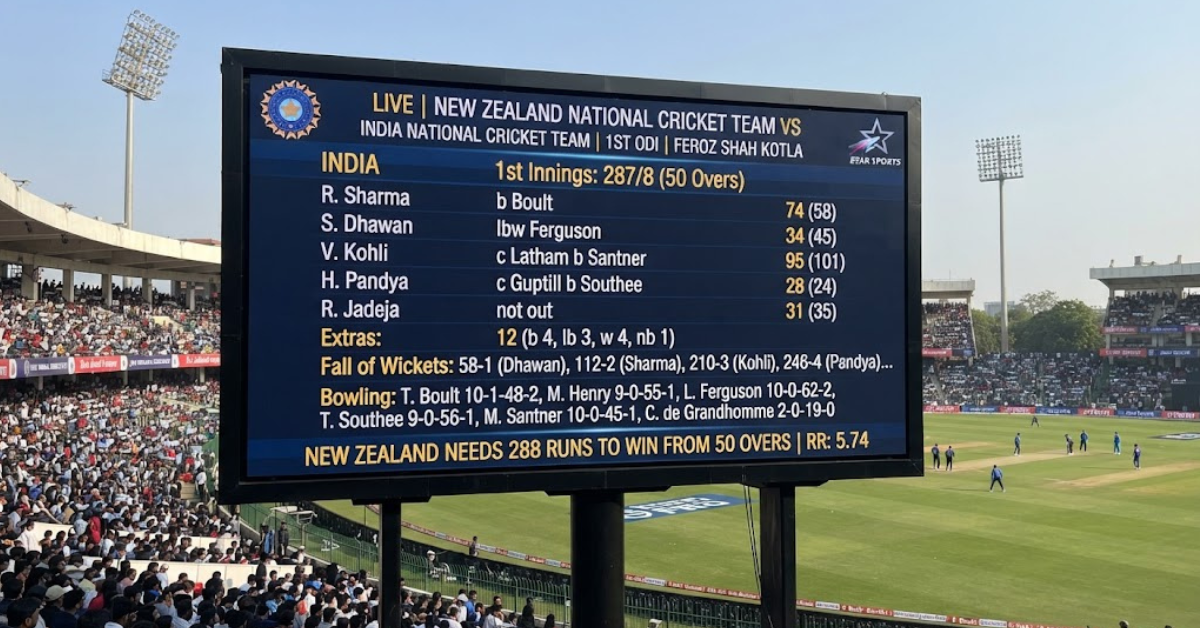
A cricket scorecard can tell a story in numbers, but some matches need a little more context. The New Zealand national cricket team vs India national cricket team match scorecard from the 2025 ICC Champions Trophy final is a perfect example.
Played at the Dubai International Cricket Stadium on March 9, 2025, the final produced a tense contest. New Zealand made 251/7 from 50 overs, but India chased the target in 49 overs to win by four wickets and lift the Champions Trophy.
New Zealand vs India Match Scorecard
Here is the headline scorecard from the Champions Trophy final:
| Team | Score | Overs | Result |
| New Zealand | 251/7 | 50.0 | Lost |
| India | 254/6 | 49.0 | Won by 4 wickets |
New Zealand won the toss and elected to bat first. India eventually reached 254/6 with six deliveries remaining, completing the chase with an over to spare.
Player of the Match: Rohit Sharma — 76 runs from 83 balls.
New Zealand Batting Scorecard
New Zealand’s innings was built around a patient half-century from Daryl Mitchell and a late attacking contribution from Michael Bracewell.
| Batter | Runs | Balls | 4s | 6s | Strike Rate |
| Will Young | 15 | 23 | 2 | 0 | 65.22 |
| Rachin Ravindra | 37 | 29 | 4 | 1 | 127.59 |
| Kane Williamson | 11 | 14 | 1 | 0 | 78.57 |
| Daryl Mitchell | 63 | 101 | 3 | 0 | 62.38 |
| Tom Latham | 14 | 30 | 0 | 0 | 46.67 |
| Glenn Phillips | 34 | 52 | 2 | 1 | 65.38 |
| Michael Bracewell | 53* | 40 | 3 | 2 | 132.50 |
| Mitchell Santner | 8 | 10 | 0 | 0 | 80.00 |
| Nathan Smith | 0* | 1 | 0 | 0 | 0.00 |
| Total | 251/7 | 50 overs | 5.02 RPO |
Daryl Mitchell top-scored for New Zealand with 63 from 101 balls. Michael Bracewell provided the late acceleration, finishing unbeaten on 53 from 40 balls.
Rachin Ravindra also made a useful 37 from 29 deliveries, while Glenn Phillips contributed 34.
New Zealand’s Late Surge
New Zealand appeared to be heading toward a more modest total before Bracewell changed the tempo.
His unbeaten 53 included three fours and two sixes, giving New Zealand a strong finish and taking the total to 251/7.
That late acceleration proved important because India had to maintain a steady scoring rate throughout the chase.
India Bowling Scorecard
India’s spinners played a major role in restricting New Zealand’s middle order.
| Bowler | Overs | Runs | Wickets | Economy |
| Varun Chakravarthy | 10 | 45 | 2 | 4.50 |
| Kuldeep Yadav | 10 | 40 | 2 | 4.00 |
| Ravindra Jadeja | 10 | 30 | 1 | 3.00 |
| Mohammed Shami | 9 | 74 | 1 | 8.22 |
| Hardik Pandya | 6 | 46 | 0 | 7.66 |
| Axar Patel | 5 | 16 | 0 | 3.20 |
Kuldeep Yadav and Varun Chakravarthy each took two wickets. Jadeja was particularly economical, conceding only 30 runs from his 10 overs.
The spin attack was crucial because New Zealand’s innings never developed into a sustained high-scoring assault.
India Batting Scorecard
India’s chase was led by captain Rohit Sharma, who produced the innings of the match.
| Batter | Runs | Balls | 4s | 6s | Strike Rate |
| Rohit Sharma | 76 | 83 | 7 | 3 | 91.56 |
| Shubman Gill | 31 | 50 | 0 | 1 | 62.00 |
| Virat Kohli | 1 | 2 | 0 | 0 | 50.00 |
| Shreyas Iyer | 48 | 62 | 2 | 2 | 77.42 |
| Axar Patel | 29 | 40 | 1 | 1 | 72.50 |
| KL Rahul | 34* | 33 | 1 | 1 | 103.03 |
| Hardik Pandya | 18 | 18 | 1 | 1 | 100.00 |
| Ravindra Jadeja | 9* | 6 | 1 | 0 | 150.00 |
| Total | 254/6 | 49 overs | 5.18 RPO |
Rohit Sharma’s 76 was the foundation of India’s successful chase. Shreyas Iyer added 48, while KL Rahul remained unbeaten on 34.
Ravindra Jadeja eventually hit the winning runs, finishing unbeaten on nine from six balls.
New Zealand Bowling Scorecard
New Zealand’s bowlers kept India under pressure during the middle part of the chase.
| Bowler | Overs | Runs | Wickets | Economy |
| Michael Bracewell | 10 | 28 | 2 | 2.80 |
| Mitchell Santner | 10 | 46 | 2 | 4.60 |
| Rachin Ravindra | 10 | 47 | 1 | 4.70 |
| Kyle Jamieson | 5 | 24 | 1 | 4.80 |
| Will O’Rourke | 7 | 56 | 0 | 8.00 |
| Nathan Smith | 2 | 22 | 0 | 11.00 |
| Glenn Phillips | 5 | 31 | 0 | 6.20 |
Bracewell was especially effective, taking two wickets while conceding just 28 runs from his 10 overs. Santner also claimed two wickets.
How the India vs New Zealand Final Unfolded
The match went through several distinct phases.
1. New Zealand Started Well
Will Young and Rachin Ravindra put together 57 runs for the opening wicket. India responded by introducing spin early, and Varun Chakravarthy soon removed Young for 15.
Kuldeep Yadav then dismissed Ravindra and Kane Williamson, putting New Zealand under pressure.
2. Daryl Mitchell Stabilized the Innings
After the early wickets, Daryl Mitchell played a patient innings.
His 63 from 101 balls provided New Zealand with stability, although the relatively slow scoring rate meant the innings required a late push.
3. Bracewell Changed the Momentum
Michael Bracewell’s unbeaten 53 from 40 balls gave New Zealand the finish it needed.
His aggressive batting helped New Zealand reach 251/7, a total that looked competitive on a surface where spin was playing a significant role.
4. Rohit Sharma Set Up the Chase
India’s reply began positively, with Rohit Sharma and Shubman Gill establishing a solid platform.
Rohit eventually reached 76 before being stumped off Rachin Ravindra. By then, however, he had given India enough momentum to keep the chase under control.
5. New Zealand Created Late Pressure
India suffered a mini-collapse in the middle overs.
Virat Kohli fell for one, Rohit was dismissed for 76, and Shreyas Iyer later departed for 48. Axar Patel also fell with India still needing 49 runs.
But KL Rahul and Hardik Pandya helped India move closer before Pandya was dismissed.
6. Jadeja Finished the Job
With 11 runs still required, Pandya fell to Kyle Jamieson.
KL Rahul and Ravindra Jadeja remained composed, and Jadeja struck the winning boundary to complete India’s four-wicket victory with six balls remaining.
Why Rohit Sharma’s 76 Was So Important
Rohit Sharma’s innings was more than the highest individual score of the match.
He provided India with a controlled start and absorbed some of the pressure created by New Zealand’s spinners. His seven fours and three sixes helped India maintain the required scoring rate without taking unnecessary risks.
His dismissal briefly gave New Zealand hope, but the platform he created proved valuable.
What Made the Match Interesting?
The final was particularly fascinating because both teams had periods of control.
New Zealand’s bowlers created pressure after India’s strong beginning, while India’s spinners repeatedly disrupted New Zealand’s batting lineup.
Three things ultimately separated the teams:
- India’s ability to build partnerships
- Rohit Sharma’s influential 76
- KL Rahul and Ravindra Jadeja’s composure at the finish
India’s depth allowed them to absorb wickets without losing control of the chase.
India vs New Zealand Champions Trophy 2025 Result
India won the final by four wickets, reaching 254/6 in 49 overs after New Zealand posted 251/7.
The victory was particularly significant because India completed the tournament unbeaten and became the first team to win the Champions Trophy three times.
New Zealand had still produced a strong campaign, reaching the final after a competitive tournament, but India’s chase proved decisive on the biggest stage.
How to Read a New Zealand vs India Scorecard
If you’re new to cricket statistics, a scorecard can initially look complicated.
Here are a few common figures:
- 251/7: New Zealand scored 251 runs and lost seven wickets.
- 50 overs: New Zealand used its full 50-over allocation.
- 254/6: India scored 254 runs while losing six wickets.
- 49 overs: India reached the target after 49 overs.
- 76 (83): Rohit Sharma scored 76 runs from 83 balls.
- 53:* The asterisk means Michael Bracewell was not out.
- 2/40: Kuldeep Yadav took two wickets and conceded 40 runs.
Once you understand these basics, the scorecard becomes an easy way to follow the entire match.
Frequently Asked Questions
What was the New Zealand national cricket team vs India national cricket team match scorecard?
In the 2025 Champions Trophy final, New Zealand scored 251/7 in 50 overs, while India scored 254/6 in 49 overs. India won by four wickets.
Who won the New Zealand vs India Champions Trophy final?
India won the final by four wickets at the Dubai International Cricket Stadium on March 9, 2025.
Who was Player of the Match?
Rohit Sharma was named Player of the Match after scoring 76 runs from 83 balls.
Who scored the most runs for New Zealand?
Daryl Mitchell was New Zealand’s highest scorer with 63 runs from 101 balls. Michael Bracewell made an unbeaten 53 from 40 balls.
Who scored the most runs for India?
Rohit Sharma top-scored for India with 76 runs. Shreyas Iyer was India’s second-highest scorer with 48.
How many runs did India need to win?
India needed 252 runs to win after New Zealand finished on 251/7. India reached 254/6, winning by four wickets with six balls remaining.
Who were India’s leading bowlers?
Kuldeep Yadav and Varun Chakravarthy each took two wickets. Ravindra Jadeja and Mohammed Shami took one wicket apiece.
Who were New Zealand’s best bowlers?
Michael Bracewell and Mitchell Santner each took two Indian wickets. Kyle Jamieson also claimed one wicket.
Conclusion: New Zealand vs India Match Scorecard
The New Zealand national cricket team vs India national cricket team match scorecard from the 2025 Champions Trophy final captures a closely fought contest that ultimately went India’s way.
New Zealand posted a competitive 251/7, with Daryl Mitchell scoring 63 and Michael Bracewell adding an unbeaten 53. India responded with 254/6, led by Rohit Sharma’s 76 and supported by Shreyas Iyer, KL Rahul, Hardik Pandya, and Ravindra Jadeja.
The final numbers show a four-wicket Indian victory, but the scorecard tells a richer story: New Zealand created pressure, India lost important wickets, and yet the defending champions stayed composed enough to finish the chase with an over remaining.
For anyone checking a New Zealand vs India match scorecard, the final score is only the starting point. Looking at individual batting performances, bowling figures, partnerships, wickets, and the required run rate gives you a much clearer picture of why India lifted the trophy.